
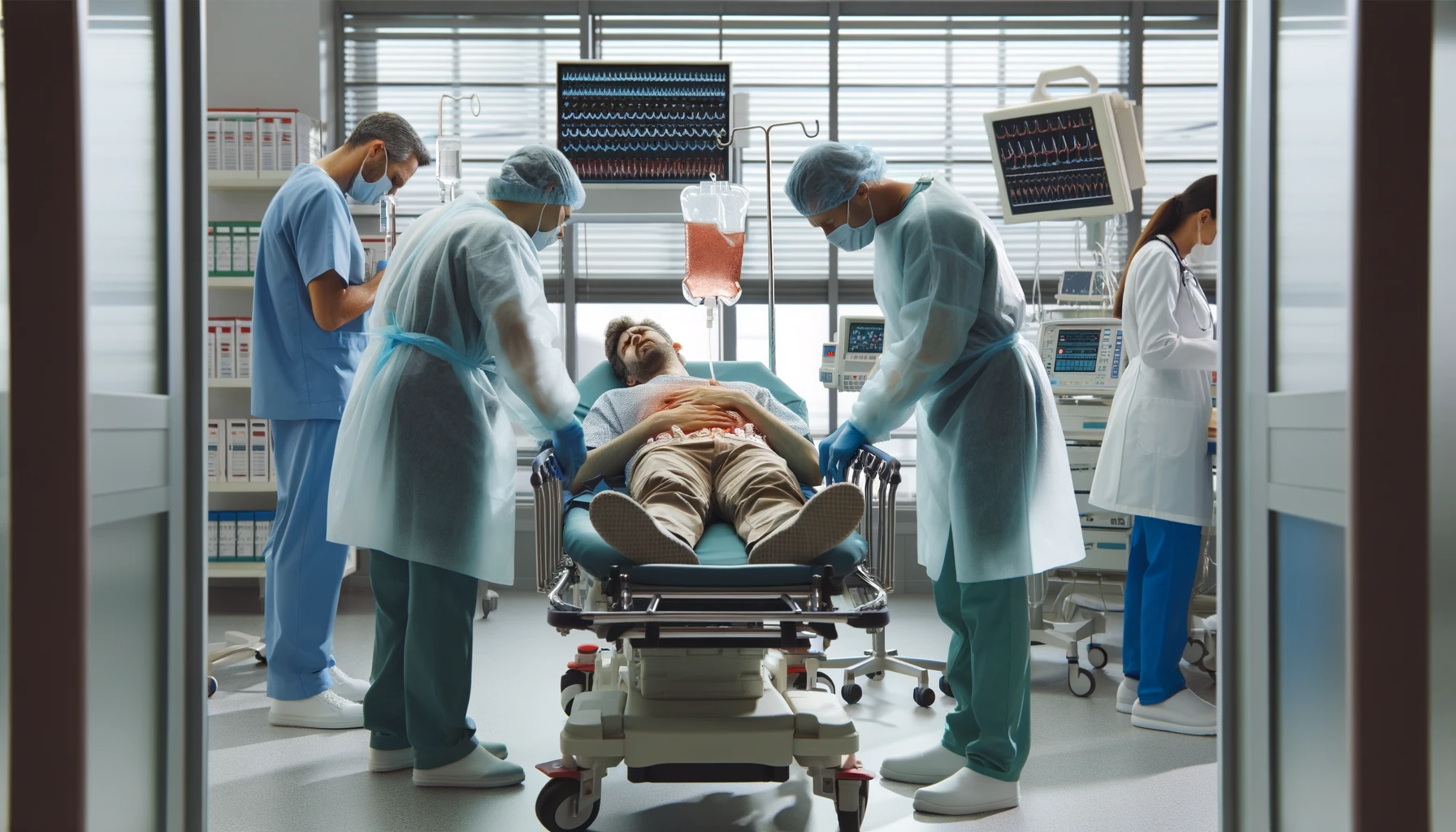
Scenario Vignette
You are the on-call general surgery CT1. A 44 year old male patient arrives in A&E following a road traffic accident in which he was the restrained passenger in the car. He is complaining of severe abdominal pain and his vital signs include:
- Respiratory rate 24
- Heart rate 130
- Blood Pressure 105/64
- Oxygen saturation 94%
Q1: Describe your initial assessment and management of this patient ?
Remember: Trauma Bundle
Opening Statement:
This is a critically unwell patient following a major trauma and I would ensure he is managed in the A&E resuscitation bay and that a trauma call has been put out with all members of the trauma team in attendance.
I would commence the primary survey following the principles of Advanced Trauma Life Support (ATLS) with simultaneous assessment and resuscitation of the patient in an A to E manner.
Airway and C-Spine Immobilisation:
- Assess airway patency using appropriate adjuncts if required
- Triple immobilisation of the cervical spine.
- Initiate 15L oxygen via a non-rebreather mask
Breathing:
Vitals:
- Oxygen saturations, respiratory rate
Assess:
- Palpate trachea
- Inspect chest during respiration for symmetry and bruising
- Palpate for chest expansion, flail segments and crepitus
- Auscultate and percuss chest for evidence of haemo/pneumothorax
Test:
- Venous/Arterial blood gas
Intervene:
- Nil in this scenario
Circulation:
Main concern:
- This patient is hypotensive and tachycardic and in the trauma setting I am concerned he is in hypovolaemic shock. I suspect an abdominal source of haemorrhage due to the severe abdominal pain, but I would also fully assess him for other sources.
- I would escalate to my seniors for early support. In the mean time I would begin my assessment.
Vitals:
- Heart rate, blood pressure, continuous cardiac monitor as in resus
Assess:
- Peripheral and central capillary refill times
- Peripheral pulse rate and character and JVP
- Auscultate heart sounds for haemopericardium
- Assess for source of haemorrhage (blood on the floor + 4 more - chest, abdomen, pelvis and long bones).
- Assess abdomen for bruising / guarding / peritonism suggestive of an abdominal bleed.
Test:
- Bilateral, large bore, IV access
- Trauma bloods: Full blood count, Urea & electrolytes, Liver function tests, clotting screen, lactate, group and screen or cross match if active haemorrhage
- Consider FAST scan locate any source of haemorrhage - focus on abdomen in this case
- 12-lead ECG
Intervene:
- Fluid resuscitation with 1000mls of a warmed crystalloid such as Hartmann's. Repeated as necessary.
- Consider transfusion of O negative or type specific blood in major haemorrhage.
- IV Tranexamic Acid 1g
- Consider activation major haemorrhage pathway.
- Re-assess following interventions and consider escalating patient at this stage.
Disability:
Vitals:
- Temperature
Assess:
- Major trauma with a significant risk of intracranial haemorrhage
- AVPU or calculate full GCS
- Pupil reactivity
Test:
- Blood sugar
Intervene:
- Patient warming to prevent hypothermia.
Exposure:
- Full top-to-toe examination for missed injuries whilst maintaining dignity and preventing hypothermia
- Secondary and tertiary surveys
- AMPLE history
Escalate:
- Early escalation to the senior members of your team for review
- Critically unwell patient requiring multidisciplinary management.
- Going to theatre bundle
Reassess:
- Continuous re-assessment in an A to E manner to monitor response to interventions or detect any deterioration in clinical condition.
Q2: What are your main concerns ?
The patient is critically unwell with evidence of shock. I am most concerned about an intra-abdominal haemorrhage, sources of which may include:
- Splenic rupture
- Liver laceration
- Genitourinary injury
- Retroperitoneal haemorrhage
- Vascular injury
I would also exclude other sources of haemorrhagic shock
- Haemothorax
- Pelvic fracture
- Long bone fracture
- External injury
Although less likely in this scenario I would consider other sources of shock:
- Obstructive: Tension pneumothorax, cardiac tamponade
- Neurogenic/spinal
Q3: What investigations would you consider ?
You have probably mentioned some of these already, but don’t be afraid to repeat yourself if the question is specifically asked.
- Bloods: Full blood count, Urea and electrolytes, Liver function tests, coagulation screen, lactate, cross match 4 units
- Arterial or venous blood gas
- FAST scan - can identify free fluid in abdomen
- CT Abdominal with contrast / CT Angiogram (this may be part of the trauma series) if the patient is stable enough for transfer
Q4: The CT scan reveals splenic laceration. What is the next management ?
This is a haemodynamically unstable patient with a proven splenic laceration. He is likely to have a high grade splenic injury which may necessitate surgical or interventional radiological management.
- Escalate promptly to senior
- Reassess patient in A to E manner with appropriate resuscitation and consider blood products
- Multi-disciplinary management: Senior Trauma/General surgeon, radiologist, anaesthetist, critical care outreach, senior A&E clinician,
- Going to theatre bundle
Splenic injuries are graded following the American Association for the Surgery of Trauma (AAST) Organ injury scale.
- Subcapsular haematoma <10% OR laceration through capsule <1cm in depth
- Subcapsular haematoma 10 - 50% OR Intraparenchymal haematoma <5cm OR laceration through capsule 1 - 3 cm in depth
- Subcapsular haematoma >50% OR Intraparenchymal haematoma >5cm OR ruptured subcapsular/intraparenchymal haematoma OR Laceration >3cm in depth
- Laceration through segmental or hilar vessels causing devascularisation of >25% of the organ
- Shattered spleen OR laceration through hilum which devascularises the spleen
Whilst you don’t need to memorise the entire system it is worth being aware of the criteria for higher grade injuries. Management of injury depends on the grade of injury and the haemodynamic status of the patient.
The management can be split into conservative, medical, interventional and surgical.
Conservative: The majority (60-90%) of splenic injuries are managed conservatively to preserve splenic function. This depends on the patient being haemodynamically stable with no evidence of ongoing haemorrhage. Therefore, conservative management is not an option here.
Medical: Fluid resuscitation to ensure the patient is not hypoperfusing their major organs. Blood transfusions with assistance from the haematology team to ensure platelets and coagulative function are maintained. Tranexamic acid 1g intravenously. Analgesia as needed.
Interventional Radiology: Embolisation of large or small vessels may be employed to stem haemorrhage. This is more likely to be utilised in stable patients with ongoing haemorrhage or those who fail conservative management.
Surgery: Patients with ongoing haemodynamic instability or proven high grade splenic injury may require laparotomy. Surgery may be able to repair parenchymal or vascular injuries, but if this is not possible splenectomy may be necessary. Following splenectomy patient require vaccination against encapsulated bacteria (Strep pneumoniae, haemophilus influenza, Neisseria meningitides) and consideration of prophylactic antibiotics.
Q5: What is shock ?
Shock is life threatening circulatory failure resulting in inadequate tissue perfusion.
Shock can broadly be classified into four groups:
- Hypovolaemic: Haemorrhagic, GI losses, third space losses
- Distributive: Septic, anaphylactic, neurogenic, endocrine (Addisonian)
- Obstructive: Extra-cardiac disease suppressing LV output
- Cardiogenic: Arrhythmias, cardiomyopathy
Q6: Do you know how to classify shock ?
Scenario Analysis:
Trauma is the leading cause of death worldwide - with fifty percent of trauma deaths being attributable to haemorrhage and haemorrhagic shock.
Shock refers to inadequate tissue perfusion due to the inability to supply enough oxygen to meet the metabolic demands.
If a patient has evidence of haemorrhagic shock the source is highly likely to be one of the following: external injury, intra-thoracic injury, intra-abdominal injury, pelvic injury or long bone (i.e. femur) fracture - the blood on the floor and 4 more memory aide.
This is due to the fact that these cavities have a large enough volume to exsanguinate into (e.g. the thigh can hold 1-2 litres of blood) whereas other cavities such as the skull simply would not hold a high enough volume of blood for the patient to be overtly shocked.
Early recognition and treatment of shock is vital. Knowledge of the four grades of haemorrhagic shock detailed above demonstrates how there is a high degree of physiological compensation for large volumes of blood loss.
Once hypotension is present the patient has already lost at least one third of their circulating volume and is critically unwell (Grade 3-4).
Loss of this amount of blood and the coagulation factors with haemodilution through fluid resuscitation risks a trauma induced coagulopathy and if not corrected can result in the development of the ‘lethal triad’ - coagulopathy, acidosis and hypothermia with the latter two significantly worsening the coagulopathy resulting in poor prognosis.
For severe haemorrhagic shock damage control resuscitation is often implemented. This approach focuses on permissive hypotension, early resuscitation with blood products and haemorrhage control.
Permissive hypotension in theory aids haemorrhage control with the caveat of reducing end organ perfusion, the evidence is mixed and trauma so be cautious if mentioning this in your CST interview.
Early resuscitation with blood products, often in a 1:1:1 ratio (packed red cells: platelets: plasma), aids haemostasis and improves survival. Similarly, administration of tranexamic acid improves outcomes (CRASH-2 study).
Scenario Guide:
It is highly likely that one of your clinical stations will be an ATLS style trauma resuscitation. This station will test your ability to perform an A to E assessment whilst recognising shock and initiating initial management. Although the diagnosis in this case was splenic rupture, the vast majority of the assessment and management are applicable to any cause of haemorrhagic shock.
The examiners will be assessing you on a thorough and safe assessment, resuscitation and escalation to seniors. You will likely be asked about possible differentials and appropriate investigations.
Being slick and well rehearsed in these answers will score you higher marks, and you should offer your answers to these questions once finished your A to E as minimal prompting will impress your examiners.
Tips for the Top Scorers:
- Trauma Resuscitation Bundle
- Blood on the floor AND four more assessment in circulation
- Assess for coagulopathies and correction if present
- Don’t forget cross match and resuscitation with O negative/type specific blood alongside platelets and plasma (plasma for clotting factors)
- FAST scans provide a quick and highly specific diagnostic tool
- Recognise the severity of shock early and likelihood patient will need theatre - going to theatre bundle
References:
- ATLS 10th Edition
- Splenic Rupture